 516.407.9795
 pamela@adhdiq.com
 2266 1/2 East Main Street Suite D Bexley, Ohio 43209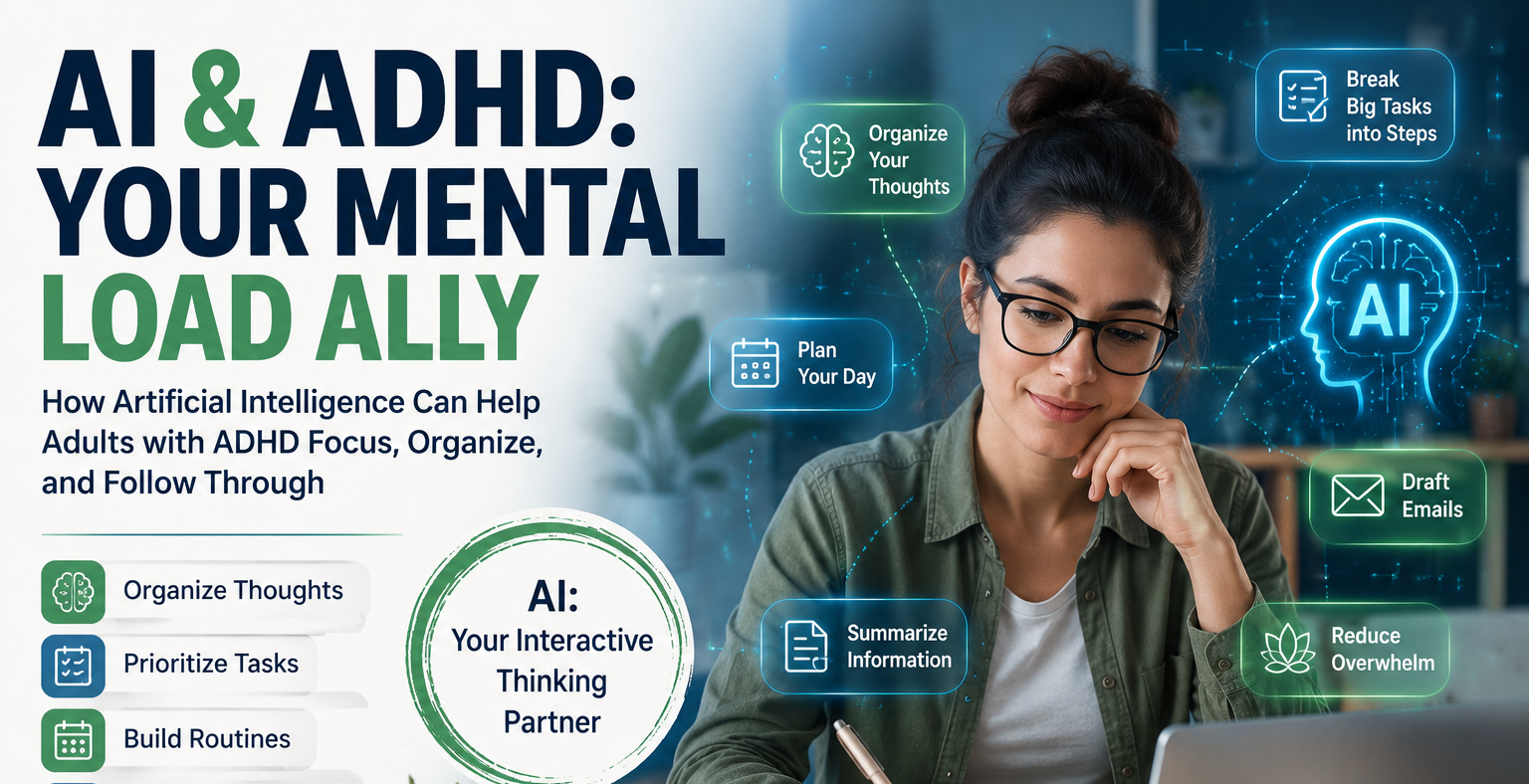
AI and ADHD
For many adults living with ADHD, the hardest part of the day isn’t a lack of intelligence or motivation—it’s managing the invisible mental workload.
Remembering appointments. Prioritizing tasks. Starting projects. Organizing thoughts. Replying to emails. Planning meals. Following through.
These everyday responsibilities all rely on executive functions—the brain’s management system. When executive functioning is affected by ADHD, even simple tasks can feel overwhelming.
Today, Artificial Intelligence (AI) is offering something many adults with ADHD have never had before: an interactive thinking partner.
But is AI the answer? Or just another distraction?
Let’s explore how AI can support ADHD—and where healthy boundaries matter.
What Is “Mental Load”?
Mental load refers to the constant effort required to keep track of everything happening in your life.
For someone with ADHD, that mental checklist often feels like having dozens of browser tabs open at once:
- Things you need to remember
- Conversations you need to have
- Bills to pay
- Emails to answer
- Work deadlines
- Family responsibilities
- Appointments
- Shopping lists
Trying to hold all of this in working memory is exhausting.
Rather than carrying everything in your head, AI allows you to externalize your mental load.
Instead of remembering everything…
…you can build systems that remember with you.
AI as Your Executive Function Assistant
Think of AI as an extension of your executive functioning—not a replacement for it.
Many adults with ADHD are now using AI to help:
Break Big Projects into Smaller Steps
Large tasks often trigger overwhelm.
Instead of seeing one impossible project, AI can help create manageable action steps.
Instead of:
“Write a business proposal.”
AI helps create:
- Outline the proposal
- Research competitors
- Write the introduction
- Add pricing
- Review
- Send
The task suddenly feels possible.
Organize Thoughts
Many ADHD adults know exactly what they want to say—but struggle putting thoughts into words.
AI can help:
- Draft emails
- Create reports
- Rewrite messages
- Organize brainstorming sessions
- Structure presentations
The ideas remain yours.
AI simply helps organize them.
Prioritize When Everything Feels Urgent
One common ADHD challenge is deciding:
“What should I do first?”
When every task feels equally important, decision paralysis often follows.
AI can help prioritize based on:
- Deadlines
- Importance
- Energy level
- Available time
Sometimes one clear next step is all you need.
Build Daily Routines
Consistency is difficult when executive functioning fluctuates.
AI can help create routines that actually fit your lifestyle.
Examples include:
- Morning routines
- Evening shutdown checklists
- Medication reminders
- Exercise schedules
- Focus sessions
- Weekly planning
The goal isn’t perfection.
It’s reducing decision fatigue.
Summarize Information
- Long articles.
- Meeting notes.
- Research papers.
- Policies.
- Books.
Many people with ADHD struggle to process large amounts of information quickly.
AI can summarize key ideas, making learning faster and less overwhelming.
Reduce Emotional Overwhelm
ADHD isn’t only about attention.
Emotional regulation is often part of the experience.
When anxiety, frustration, or overwhelm appears, AI can help by asking reflective questions like:
- What is causing the stress?
- Which part feels hardest?
- What’s one small step you can take today?
- What would “good enough” look like?
Sometimes slowing down your thinking is enough to regain momentum.
Why AI Feels Different
Many productivity apps fail because they expect the user to stay consistent.
- AI is different.
- It responds.
- It adapts.
- It explains.
- It encourages.
Instead of staring at a blank planner, you’re having a conversation.
That interaction often feels more natural for ADHD brains, which tend to respond well to novelty, immediate feedback, and dynamic engagement.
But AI Isn’t a Cure
AI is a powerful tool—but it has limits.
It cannot replace:
- Clinical evaluation
- Therapy
- ADHD coaching
- Medication when appropriate
- Healthy relationships
- Self-awareness
- Professional judgment
AI supports executive functioning.
It does not replace human growth.
The Risk of “Productive Procrastination”
Ironically, AI can become another form of procrastination.
You may spend hours:
- Perfecting plans
- Creating elaborate schedules
- Researching endlessly
- Optimizing productivity systems
Without actually taking action.
Planning feels productive.
But progress happens in the real world.
Ask yourself:
“Am I preparing to act—or avoiding action?”
Watch Out for the Dopamine Trap
AI conversations can be engaging.
Sometimes too engaging.
For ADHD brains that naturally seek stimulation, AI may encourage:
- Endless brainstorming
- Constant idea generation
- Hyperfocus
- Overthinking
- Perfectionism
Hours can disappear while refining plans that never leave the screen.
That’s why intentional use matters.
Helpful boundaries include:
- Set a timer before opening AI.
- End each AI session with one concrete action.
- Limit planning time.
- Take regular movement breaks.
- Return to the real-world task before asking AI for more ideas.
Remember:
Helpful stimulation should lead to meaningful action.
AI Works Best Alongside Healthy Habits
The strongest ADHD support system combines technology with real-life habits.
AI works best alongside:
- Quality sleep
- Regular physical activity
- Nutritious meals
- Therapy or coaching
- Medication when prescribed
- Family and social support
- Organized physical spaces
- Consistent routines
Technology should strengthen these foundations—not replace them.
From Working Harder to Working Smarter
For years, many adults with ADHD have relied on stress, urgency, or last-minute pressure to get things done.
AI offers a healthier alternative.
Instead of carrying every responsibility alone, you can distribute the workload across supportive systems.
That’s not weakness.
It’s smart design.
Using tools that match how your brain works isn’t “cheating”—it’s adapting.
Just as glasses help people see and calendars help people remember, AI can help reduce cognitive overload and improve follow-through.
The Bottom Line
Artificial Intelligence won’t cure ADHD.
But it may become one of the most valuable executive-function tools available to adults living with ADHD.
Used intentionally, AI can help you:
- Reduce mental clutter
- Organize complex tasks
- Improve follow-through
- Build sustainable routines
- Clarify priorities
- Lower overwhelm
- Create more space for creativity, relationships, and meaningful work
The goal isn’t to think less.
It’s to think with better support.
When AI is used wisely, it becomes more than technology.
It becomes a partner in helping you live smarter with ADHD.
About ADHD IQ
At ADHD IQ, we combine evidence-based education, practical strategies, and compassionate support to help adults and families better understand ADHD and build systems that work in everyday life.
Explore more resources: www.adhdiq.com